Labels

Tuesday, April 30, 2013

Finished Clam Shell

Clamshell Side
The Clam Shell is done, and ready for the Indiana gourd show this weekend.  Here is the side view showing the chipcarved centre insert and the outer rim.  The edges are painted in pearl-toned paint, to mimic a clam shell  The insert and rim is painted in verdigris green, like algae.
Clamshell Front
The front of the clam shell is black gesso-ed background with coloured pencil drawing of an orange fantailed goldfish.  Notice the small Inlace medallion at the base.  It is green Inlace with cut-outs on a pearl-toned background.
Back View


This is the back panel of the clam shell, depicting a chocolate brown fantailed goldfish.  It too is coloured pencil on black gesso.


Below is the view of the top of the clamshell.  It shows you the third medallion that was carved from two different colours of Inlace.  The white was carved to show the green inlace below and inset into the central insert.


Top View  


Tuesday, April 9, 2013

Current Project: Life in a Goldfish Bowl


Now that the Dragon's Eye is done, Gary has started work on another of his favourite themes....fish.
I don't know what his fascination is with dragons and fish, but they are a recurring theme in a lot of his work, and are often combined with celtic knots.  This one doesn't appear to have any knots in it, but it is far from finished.  He is planning on making a clam-shaped sculpture with chipcarving accents and two-sided coloured pencil drawings.

What he has done so far:
This is the base for the clam shell, and you can see that the sides are supported by his all-time favourite hardening agent, Bondo!    For those who aren't familiar with Bondo, it is a car-repair material that is extremely fast to set up, is very hard and can be carved, sanded or painted.  It also smells awful and makes an incredible mess when sanded!


The photo below is one of two halves of the clam shell.  Each will have a chipcarved rim, which will be painted. The centre will be gessoed and have a drawing of a gold fish done in coloured pencil.  Again, he will use Prismacolor. 


 This shows the central ring that will separate the two halves of the clam shell. It will be chipcarved and attached to the base, and the two clam shell halves will be attached to either side.


This is a sketch that Gary drew for the small Inlace medallion carvings  that will be accents for the sculpture.

When working with Inlace, he mixes it up in a small paper cup and there is always a bit left over. He saves these blanks and uses them to make medallions.  Below you can see one blank, and one finished carving.  It's hard to see the fish design but it is there.


This is one of the three medallions that he has completed.  This one was made from a blank that had green in the bottom and white poured on top.  He sanded the white down until it was thin enough to carve a relief of the fish.  It is easier to see the design in this one.


Wow!  I can't believe it's been nearly 2 years since my last post.  We have been on hiatus for a while.
I don't seem to have regained my interest in gourds, but Gary has started working again.  He has decided to produce some work for the upcoming Indiana show and is busy filling the house with gourd dust and Inlace dust.  He does like working with that stuff.

Work to date: Dragon's Eye View

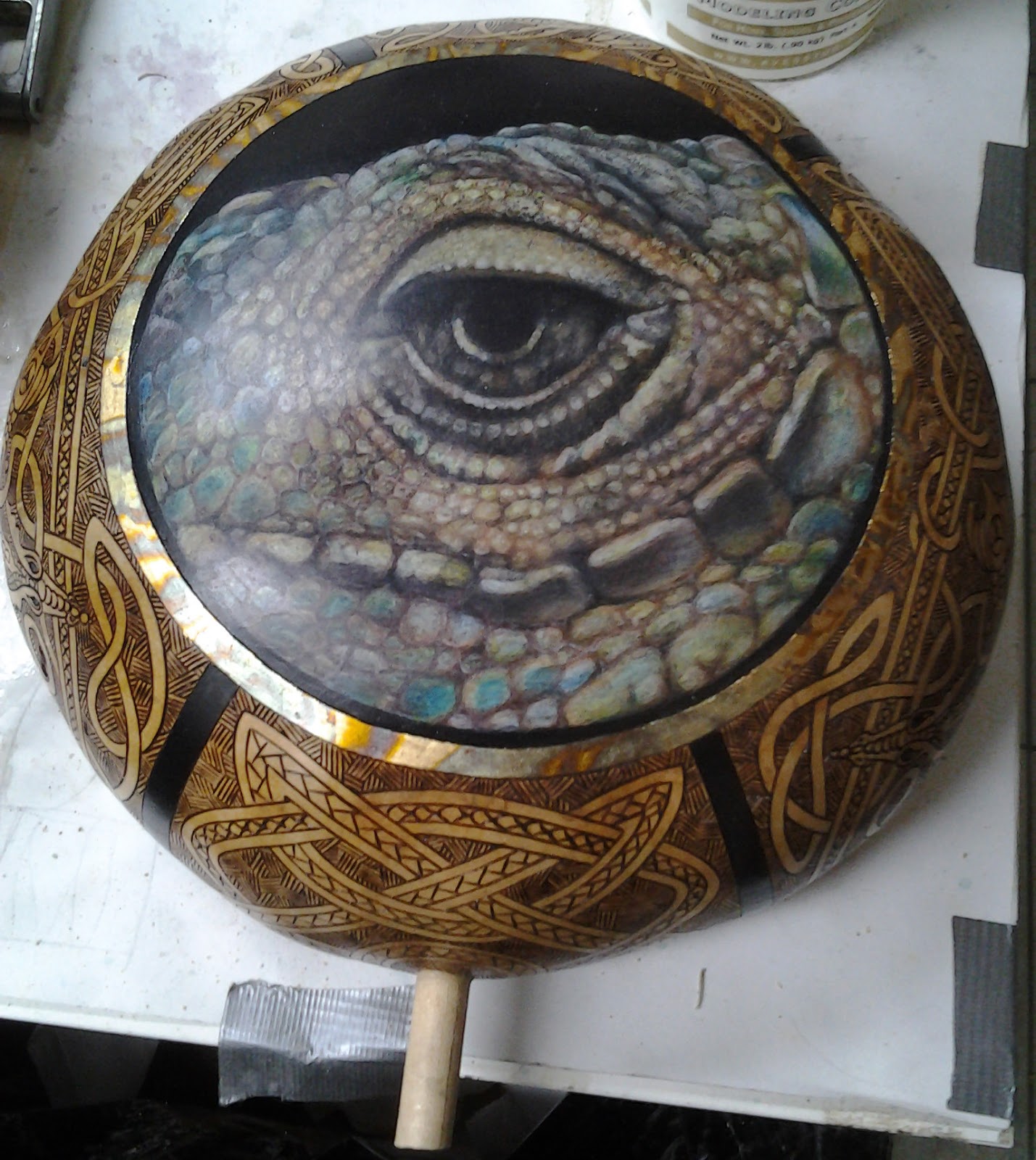
A recurring theme that shows up in almost all Gary's work is Celtic knotwork.  He is fascinated by the unlimited number of patterns that can be created using intertwining lines.  Here is the base he is using for his Dragon's Eye piece.  As you can see, it is a celtic knot burned onto a gourd piece.  He originally intended to have the small egg gourd as support, but changed his mind because it affected the stability of the finished piece.


Another recurring theme is his love of dragons.  The uglier the better! The photo below shows half a canteen gourd with celtic knotwork dragons burned around the outside. The centre is done in coloured pencil, using Prismacolor. There is a rim of gold metallic foil around the drawing to separate it from the burned patterns. On the back of this half, which you can see in the photo of the finished front, is a rim of carved Inlace.  Notice the dowel in the bottom that will hold the piece together.


The front of the sculpture (below) is fully carved. It is another canteen gourd section, smaller than the first and will fit inside the larger canteen half.  The water and waves are carved from  two colours of Inlace.  The dragon hovering above the waves is carved into the gourd face and painted.  The outside rim of this canteen gourd is carved in another celtic weave.


Here is the front of the finished sculpture.  You can now see the carved Inlace rim on the larger canteen gourd that makes up the back half.  The small front fits inside the back piece and is doweled in place. 


Here is the mounted back section.


The last photo shows you the entire sculpture from the side.  Here you can see in more detail how the dragons weave in and out of each other.


Sunday, August 21, 2011

Additional gourds from summer 2011

We have been working on producing gourds for a new show we have entered for this fall.  It's the art show at Ball's Falls Conservation area near St. Catharine's, ON.
It has been going for several years and has a reputation for offering fine arts and crafts, so we are hoping that we will do well.  Gourds in Ontario are not big sellers in most markets.
I have been weaving and coiling on several pieces, which I refer to as my production gourds, since they are geared to sell and are not extremely complicated, so I can do them fairly quickly.  I haven't really been exploring my more complex coiling designs for a year or so.  I'm hoping to find my muse one day soon and get motivated.

GARY'S FUSCHIA VASE
This gourd is tall and slim and very delicate looking. It is constructed of three pieces
of gourd, fully carved and the centre section gessoed and pencil crayoned.
The base is made in two sections. The lower section has a relief carved motif of leaves around the edge.
The second section is also carved and gives a 3D effect to the base.  The gourd was left unfinished and sealed with Deft.


The top few inches of the gourd have been carved through in a leaf pattern with the motif from the base repeated.  Below the pencil crayoned section, there is an additional section of sculptural carving.  Both these sections have been left natural and sealed with Deft.


Below are a few of the pieces that I have been working on.  Nothing too elaborate, alas.


This is one of my weaving pieces.  I used paper core, danish cord, dyed reed and pandora-style glass beads.  It is quite large.


This one has blue dyed reed woven over black round reed. A round base was made
from a gourd piece and attached.


This is a fairly large fruit bowl, done using round reed and dyed caning material. A small gourd base has been added.


Very large gourd base, with dyed reed and caning material to form a basket.


Something different.  Gary had done a sample carving for one of his classes on half a gourd and was going to throw it out.  I used round reed to make a frame around it and it will be a wall plaque.

More to come, since we need to have a lot more stock for October.  I'm going to have to stop sitting on my thumbs and actually start producing.

Summer 2011

Well summer 2011 has flown by, with not much gourding done on my part.  I seem to have started a new career without really planning it.  I've been face painting almost every weekend this summer, and that seems to be where my creative juices are flowing.

I did promise my friend in Michigan that I would update my blog to show her Gary's latest works, so Lynette, this is for you.


 ART NOUVEAU VASE. 
This vase is fairly large, and is constructed from two almost perfectly round basketball gourds, and a couple of bits from other gourds.  The internal gourd is carved through in an open work design, and then painted and metal leafed.


A collar was created from a snake gourd piece, and added to the smaller ball to give it shape and depth.  The collar was carved and painted and attached to 'flying buttresses".
The buttresses were cut from the second basketball gourd, carved and painted and had joining pieces added on the bottom so that the outer gourd would fit snuggly.  The additional pieces were also carved from gourd bits.


The bottom section of the second basketball gourd was fully carved  and painted to look like a piece of bronze. It was mounted on a round section of gourd.

Notice the pegs on the top of the supports.  They fit into the buttresses and are glued to give strength.


This is the view from the top.  You can see that the added collar and buttresses have been smoothed to form a throat into the body of the gourd. You can also see the design in more detail.


The pieces were then glued together to form the whole.

Friday, April 8, 2011

Murphy's Law

Murphy has struck again!
Two of Gary's gourds that were given to family members, have met with accidents.


The large dragon gourd, which is about 2 feet round was shattered during home renovations by "unknown" assailants. I think someone dropped a 2X4 on it. LOL We've promised our niece and nephew that we will repair it if possible.


The Samurai Warrior was given to my son in North Carolina and was proudly displayed on his mantle. It is made up of several parts, all carved and decorated with Inlace, which has also been carved and inlaid with a second colour. His curious cat wanted to check it out, and bumped it off onto the floor. I'm not sure if we can repair it, since we haven't seen it yet.

Oh well, if pieces of art are going to be displayed I guess you have to expect that bad things can happen!

Tuesday, April 5, 2011

THE PARROT'S NEST
Gary has finished his 2011 spring project. Mine is still incubating (going on a year now, almost as long as an elephant's pregnancy!)


Just as many artists use cultural symbols in their work, such as Santa Fe, tribal motifs, eskimo art symbols etc, Gary likes to relate to his ancestry with Celtic weaving, and tie the cultural beliefs and symbols into his designs.
He is moving away from the traditional bowl configuration and is now working on sculptural pieces. His latest piece is along the same lines as his last sculpture, but a bit larger, and more detailed.
It's a canteen gourd that has been taken apart, carved and painted to resemble a bird's nest and put back together.
The front is a pencil crayon drawing of a Macaw, showing all the beautiful colours of the feathers.

The sides are a carved and painted profile of the Macaw with cut-outs so that you can see into the interior of the nest. Inside are 10 golden eggs.

The back is inverted and fully carved with a celtic motif of two parrots interacting. Rather appropriate for inside the privacy of their nest, I think!

The top is carved in scrollwork that says "Parrot Nest".

A friend found the following information on the site of Sacred earth-Sacred art.
CELTIC MYTHOLOGY: MACAW known for their higly coloured and exotic plumage, these birds are highly intelligent and resourceful creatures with a great sense of fun. The energy of this bird is said to symbolize bringing 'colour and vibrancy' back into our lives, and also aid our communicative skills. Also thought to help us with both 'emotional and physical healing'. The feathers of the Macaw are highly prized by some cultures and are used in ceremonial costumes. To work with Macaw energies is to link with the energies of Mother Nature. Macaw can help us to increase our psychic and spiritual development. This bird is also strongly allied to the energies of the Sun, and therefore linked with masculine energies, helping to bring balance to the male and female aspects of self. It is also believed that Macaw energies can aid us by helping us to heighten our perceptions, our intuition, our understanding of our inner voice. Thought also to help with calming emotional anxieties and bringing about a sense of balance.